•  
The Museum of the Holy Souls in Purgatory - Rome

The Museum of the Holy Souls in Purgatory - Rome

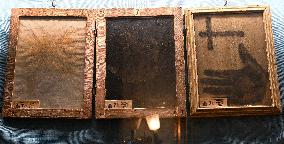
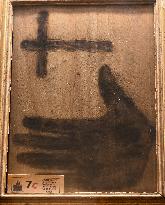
The ‘ Museum of the Holy Souls in Purgatory’ housed in a room of the small neo-Gothic church of the Sacred Heart of Suffrage (Chiesa del Sacro Cuore del Suffragio) in Rome, Italy on March 5, 2025 is one of a kind in the world as it pretends to offer undeniable proofs of the existence of Purgatory. - Pictured: - - - Burn marks left by the hands of the deceased P. Panzini, Abbot Olivetano of Mantua on 1 November 1731 on some objects belonging to the venerable mother Isabella Fornari, Abbess of the Poor Clares of the Monastery of San Francisco in Todi (Italy). One, of the left hand is on the tablet used by the Abbess for her work with a sign of the cross deeply engraved in the wood. The report of the fact is given by Fr. Isidoro Gazala of the Most Holy Crucifix, confessor of the venerable mother, to whom he ordered by obedience to cut the pieces of the cassock and the tablet, so that they could be preserved. - The tiny century-old ‘Piccolo Museo Del Purgatorio’ holds a collection of bibles, prayer books, tableto

  •  
The Museum of the Holy Souls in Purgatory - Rome

The Museum of the Holy Souls in Purgatory - Rome

The ‘ Museum of the Holy Souls in Purgatory’ housed in a room of the small neo-Gothic church of the Sacred Heart of Suffrage (Chiesa del Sacro Cuore del Suffragio) in Rome, Italy on March 5, 2025 is one of a kind in the world as it pretends to offer undeniable proofs of the existence of Purgatory. - Pictured: Burn marks left by the hand of the deceased P. Panzini, Abbot Olivetano of Mantua on 1 November 1731 on some objects belonging to the venerable mother Isabella Fornari, Abbess of the Poor Clares of the Monastery of San Francisco in Todi (Italy). One, of the left hand is on the tablet used by the Abbess for her work with a sign of the cross deeply engraved in the wood. The report of the fact is given by Fr. Isidoro Gazala of the Most Holy Crucifix, confessor of the venerable mother, to whom he ordered by obedience to cut the pieces of the cassock and the tablet, so that they could be preserved. - The tiny century-old ‘Piccolo Museo Del Purgatorio’ holds a collection of bibles, prayer books, tabletops, and

  •  
Rare Blue Room Discovered In Pompeii - Italy

Rare Blue Room Discovered In Pompeii - Italy

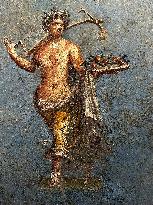
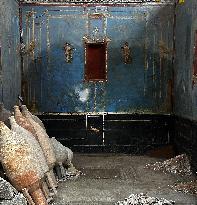
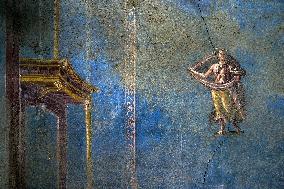
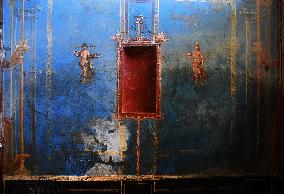
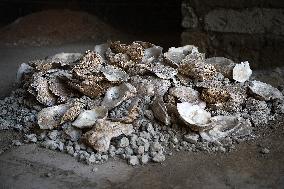
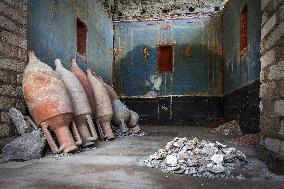
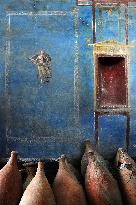
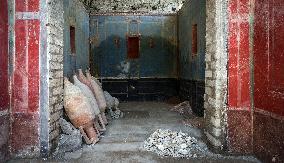
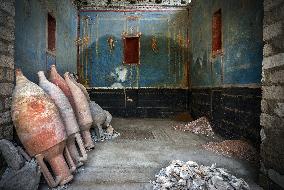
A new room in the central area of the ancient city of Pompeii, Italy emerged during excavations on May 2024. The room, which measures about 8 square meters, is painted blue and interpretable as a sacrarium, or a space dedicated to ritual activities and the storage of sacred objects. The light blue color found here was rarely witnessed in Pompeian frescoes and was generally found in highly decorative settings. Fifteen transport amphorae and a bronze set consisting of two jugs and two oil lamps were found in the room. Also present were accumulations of building materials, ready to be used in the renovations. A pile of already worn oyster shells was found on the threshold of the entrance, which were probably added to plaster and mortar mixes once they had been ground up. The figures found in the Blue Room flank niches in the center and depict the four seasons in the side niches. On the central wall are allegories of Agriculture and cattle breeding, as indicated by the attributes of a plow and a short stick used

  •  
Rare Blue Room Discovered In Pompeii - Italy

Rare Blue Room Discovered In Pompeii - Italy

A new room in the central area of the ancient city of Pompeii, Italy emerged during excavations on May 2024. The room, which measures about 8 square meters, is painted blue and interpretable as a sacrarium, or a space dedicated to ritual activities and the storage of sacred objects. The light blue color found here was rarely witnessed in Pompeian frescoes and was generally found in highly decorative settings. Fifteen transport amphorae and a bronze set consisting of two jugs and two oil lamps were found in the room. Also present were accumulations of building materials, ready to be used in the renovations. A pile of already worn oyster shells was found on the threshold of the entrance, which were probably added to plaster and mortar mixes once they had been ground up. The figures found in the Blue Room flank niches in the center and depict the four seasons in the side niches. On the central wall are allegories of Agriculture and cattle breeding, as indicated by the attributes of a plow and a short stick used

  •  
Rare Blue Room Discovered In Pompeii - Italy

Rare Blue Room Discovered In Pompeii - Italy

A new room in the central area of the ancient city of Pompeii, Italy emerged during excavations on May 2024. The room, which measures about 8 square meters, is painted blue and interpretable as a sacrarium, or a space dedicated to ritual activities and the storage of sacred objects. The light blue color found here was rarely witnessed in Pompeian frescoes and was generally found in highly decorative settings. Fifteen transport amphorae and a bronze set consisting of two jugs and two oil lamps were found in the room. Also present were accumulations of building materials, ready to be used in the renovations. A pile of already worn oyster shells was found on the threshold of the entrance, which were probably added to plaster and mortar mixes once they had been ground up. The figures found in the Blue Room flank niches in the center and depict the four seasons in the side niches. On the central wall are allegories of Agriculture and cattle breeding, as indicated by the attributes of a plow and a short stick used

  •  
Rare Blue Room Discovered In Pompeii - Italy

Rare Blue Room Discovered In Pompeii - Italy

A new room in the central area of the ancient city of Pompeii, Italy emerged during excavations on May 2024. The room, which measures about 8 square meters, is painted blue and interpretable as a sacrarium, or a space dedicated to ritual activities and the storage of sacred objects. The light blue color found here was rarely witnessed in Pompeian frescoes and was generally found in highly decorative settings. Fifteen transport amphorae and a bronze set consisting of two jugs and two oil lamps were found in the room. Also present were accumulations of building materials, ready to be used in the renovations. A pile of already worn oyster shells was found on the threshold of the entrance, which were probably added to plaster and mortar mixes once they had been ground up. The figures found in the Blue Room flank niches in the center and depict the four seasons in the side niches. On the central wall are allegories of Agriculture and cattle breeding, as indicated by the attributes of a plow and a short stick used

  •  
Rare Blue Room Discovered In Pompeii - Italy

Rare Blue Room Discovered In Pompeii - Italy

A new room in the central area of the ancient city of Pompeii, Italy emerged during excavations on May 2024. The room, which measures about 8 square meters, is painted blue and interpretable as a sacrarium, or a space dedicated to ritual activities and the storage of sacred objects. The light blue color found here was rarely witnessed in Pompeian frescoes and was generally found in highly decorative settings. Fifteen transport amphorae and a bronze set consisting of two jugs and two oil lamps were found in the room. Also present were accumulations of building materials, ready to be used in the renovations. A pile of already worn oyster shells was found on the threshold of the entrance, which were probably added to plaster and mortar mixes once they had been ground up. The figures found in the Blue Room flank niches in the center and depict the four seasons in the side niches. On the central wall are allegories of Agriculture and cattle breeding, as indicated by the attributes of a plow and a short stick used

  •  
Rare Blue Room Discovered In Pompeii - Italy

Rare Blue Room Discovered In Pompeii - Italy

A pile of already worn oyster shells was found in the new room in the central area of the ancient city of Pompeii, Italy which emerged during excavations on May 2024. The room, which measures about 8 square meters, is painted blue and interpretable as a sacrarium, or a space dedicated to ritual activities and the storage of sacred objects. The light blue color found here was rarely witnessed in Pompeian frescoes and was generally found in highly decorative settings. Fifteen transport amphorae and a bronze set consisting of two jugs and two oil lamps were found in the room. Also present were accumulations of building materials, ready to be used in the renovations. A pile of already worn oyster shells was found on the threshold of the entrance, which were probably added to plaster and mortar mixes once they had been ground up. The figures found in the Blue Room flank niches in the center and depict the four seasons in the side niches. On the central wall are allegories of Agriculture and cattle breeding, as ind

  •  
Rare Blue Room Discovered In Pompeii - Italy

Rare Blue Room Discovered In Pompeii - Italy

A new room in the central area of the ancient city of Pompeii, Italy emerged during excavations on May 2024. The room, which measures about 8 square meters, is painted blue and interpretable as a sacrarium, or a space dedicated to ritual activities and the storage of sacred objects. The light blue color found here was rarely witnessed in Pompeian frescoes and was generally found in highly decorative settings. Fifteen transport amphorae and a bronze set consisting of two jugs and two oil lamps were found in the room. Also present were accumulations of building materials, ready to be used in the renovations. A pile of already worn oyster shells was found on the threshold of the entrance, which were probably added to plaster and mortar mixes once they had been ground up. The figures found in the Blue Room flank niches in the center and depict the four seasons in the side niches. On the central wall are allegories of Agriculture and cattle breeding, as indicated by the attributes of a plow and a short stick used

  •  
Rare Blue Room Discovered In Pompeii - Italy

Rare Blue Room Discovered In Pompeii - Italy

A new room in the central area of the ancient city of Pompeii, Italy emerged during excavations on May 2024. The room, which measures about 8 square meters, is painted blue and interpretable as a sacrarium, or a space dedicated to ritual activities and the storage of sacred objects. The light blue color found here was rarely witnessed in Pompeian frescoes and was generally found in highly decorative settings. Fifteen transport amphorae and a bronze set consisting of two jugs and two oil lamps were found in the room. Also present were accumulations of building materials, ready to be used in the renovations. A pile of already worn oyster shells was found on the threshold of the entrance, which were probably added to plaster and mortar mixes once they had been ground up. The figures found in the Blue Room flank niches in the center and depict the four seasons in the side niches. On the central wall are allegories of Agriculture and cattle breeding, as indicated by the attributes of a plow and a short stick used

  •  
Rare Blue Room Discovered In Pompeii - Italy

Rare Blue Room Discovered In Pompeii - Italy

A new room in the central area of the ancient city of Pompeii, Italy emerged during excavations on May 2024. The room, which measures about 8 square meters, is painted blue and interpretable as a sacrarium, or a space dedicated to ritual activities and the storage of sacred objects. The light blue color found here was rarely witnessed in Pompeian frescoes and was generally found in highly decorative settings. Fifteen transport amphorae and a bronze set consisting of two jugs and two oil lamps were found in the room. Also present were accumulations of building materials, ready to be used in the renovations. A pile of already worn oyster shells was found on the threshold of the entrance, which were probably added to plaster and mortar mixes once they had been ground up. The figures found in the Blue Room flank niches in the center and depict the four seasons in the side niches. On the central wall are allegories of Agriculture and cattle breeding, as indicated by the attributes of a plow and a short stick used

  •  
Rare Blue Room Discovered In Pompeii - Italy

Rare Blue Room Discovered In Pompeii - Italy

A new room in the central area of the ancient city of Pompeii, Italy emerged during excavations on May 2024. The room, which measures about 8 square meters, is painted blue and interpretable as a sacrarium, or a space dedicated to ritual activities and the storage of sacred objects. The light blue color found here was rarely witnessed in Pompeian frescoes and was generally found in highly decorative settings. Fifteen transport amphorae and a bronze set consisting of two jugs and two oil lamps were found in the room. Also present were accumulations of building materials, ready to be used in the renovations. A pile of already worn oyster shells was found on the threshold of the entrance, which were probably added to plaster and mortar mixes once they had been ground up. The figures found in the Blue Room flank niches in the center and depict the four seasons in the side niches. On the central wall are allegories of Agriculture and cattle breeding, as indicated by the attributes of a plow and a short stick used

  •  
Deities restored to quake-reinforced Imperial Palace shrines

Deities restored to quake-reinforced Imperial Palace shrines

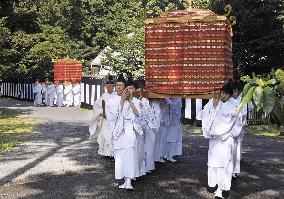
TOKYO, Japan - Shinto priests and employees of the Imperial Household Agency dressed in Shinto costumes carry the deities of the imperial family back to the three earthquake-reinforced shrines from a makeshift shrine inside the Imperial Palace on March 25. The deities, in the form of sacred objects where the spirits of deities dwell, had been temporarily housed at the makeshift shrine during earthquake-reinforcement work at the imperial shrines. The shrines, built in 1888, are used by the emperor and empress and members of the imperial family in various imperial rites. (Pool photo)

  •  
Shinto objects at Imperial Palace moved ahead of anti-quake work

Shinto objects at Imperial Palace moved ahead of anti-quake work

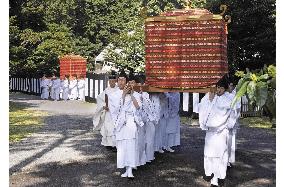
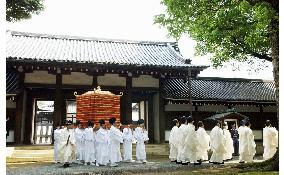
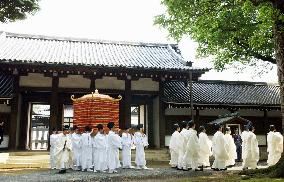
TOKYO, Japan - Led by a ritual conductor clad in white robes, servants and officials carry a ''ohaguruma'' portable shrine in a ceremony May 29 to move the sacred objects that symbolize imperial ancestors and various gods from the Imperial Palace's three main ritual rooms to a temporary room as the main rooms are to undergo anti-quake reinforcement work. (Pool photo)

  •  
Shinto objects at Imperial Palace moved ahead of anti-quake work

Shinto objects at Imperial Palace moved ahead of anti-quake work

TOKYO, Japan - Led by a ritual conductor clad in white robes, servants and officials carry a ''ohaguruma'' portable shrine in a ceremony May 29 to move the sacred objects that symbolize imperial ancestors and various gods from the Imperial Palace's three main ritual rooms to a temporary room as the main rooms are to undergo anti-quake reinforcement work. (Pool photo)(Kyodo)

  •  
Deities restored to quake-reinforced Imperial Palace shrines

Deities restored to quake-reinforced Imperial Palace shrines

TOKYO, Japan - Shinto priests and employees of the Imperial Household Agency dressed in Shinto costumes carry the deities of the imperial family back to the three earthquake-reinforced shrines from a makeshift shrine inside the Imperial Palace on March 25. The deities, in the form of sacred objects where the spirits of deities dwell, had been temporarily housed at the makeshift shrine during earthquake-reinforcement work at the imperial shrines. The shrines, built in 1888, are used by the emperor and empress and members of the imperial family in various imperial rites. (Pool photo) (Kyodo)

  •  
Ainu old people

Ainu old people

A man is wearing a ritual crown with an image on the front edge. He is wearing a costume with embroidered designs on the appliqu?. He is also wearing a war coat and holding a sacred wooden stick in his right hand. These are probably the same as the objects in photograph #2368). He is carrying a ritual sword called an emus. This photograph portrays the clothes used in Ainu rituals.==Date:unknown, Place:unknown, Photo:unknown, (Credit:Nagasaki University Library/Kyodo News Images) [Cabinet Number50‐34‐0]

  • Main
  • Top
  • Editorial
  • Creative
  • About Us
  • About ILG
  • Terms of use
  • Company
  • BEHIND
  • Price List
  • Single Plan
  • Monthly Plan
  • Services
  • Shooting
  • Rights Clearance
  • Support
  • FAQ
  • How To Buy
  • Contact Us
  • Become a Partner

© KYODO NEWS IMAGES INC

All Rights Reserved.

  • Editorial
  • Olympics
  • News
  • Sports
  • Japan
  • Tech
  • Royal
  • Disaster
  • NorthKorea
  • Old Japan
  • SNS
  • Creative
  • Food
  • Japan
  • Landscape
  • Animal
  • Popular
  • #Ukraine
  • #Thailand
  • #coronavirus
  • #N. Korea
  • #China
  • #Russia
  • #Ukraine
  • #Thailand
  • #coronavirus
  • #N. Korea
  • #China
  • #Russia
  • Food
  • Japan
  • Landscape
  • Animal
  • Olympics
  • News
  • Sports
  • Japan
  • Tech
  • Royal
  • Disaster
  • NorthKorea
  • Old Japan
  • SNS